

How to Manage Both Crypto and Fiat Finances Without Switching Between Apps ?

Tirnu — Finance Insights
The App-Switching Tax: Why Managing Crypto and Fiat Separately Is Costing You More Than You Think
Here’s a Monday morning that too many people recognize.
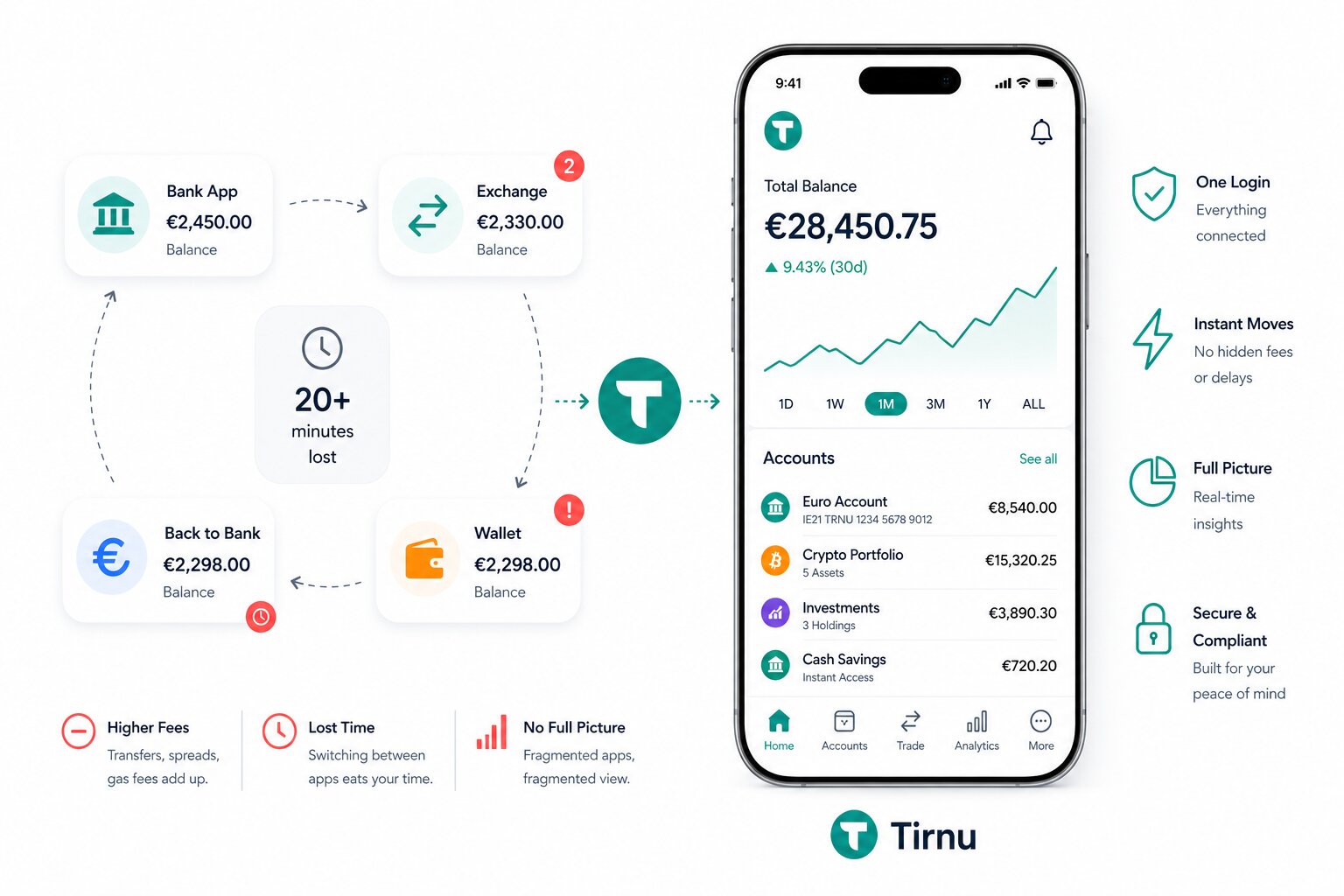
Your salary lands in your bank account. You open a second app to transfer funds to your exchange. You wait — sometimes minutes, sometimes longer. You buy crypto, then move it to a separate wallet for safekeeping. A week later, you want to take some profit: wallet to exchange, exchange to bank, bank to wherever it needs to go. By the time you’re done, you’ve touched four platforms, paid fees at two of them, and lost twenty minutes you didn’t plan to spend.
This is the hidden cost of fragmented finance. Not just money — though that adds up — but attention, time, and the low-grade stress of never having a clear picture of where you actually stand.
Two Financial Worlds That Weren’t Built to Talk to Each Other
Traditional banking and crypto didn’t grow up together. Banks run on regulated, centralized infrastructure built over decades. Crypto runs on decentralized blockchains designed specifically to bypass that infrastructure. Both have genuine strengths. But moving value between them still requires a chain of intermediaries — and every link in that chain has a fee, a delay, or a form to fill out.
The result is that anyone operating seriously in both worlds ends up managing what’s effectively two separate financial lives. One in their banking app. One spread across exchanges and wallets. Neither gives a complete picture of the other.
That’s not a personal failing. It’s a structural problem — and it’s one that’s starting to be solved.
What a Unified Platform Actually Changes
The shift isn’t just about convenience. When your fiat and crypto live in the same system, something more fundamental changes: you can actually think about your finances as a whole.
Consider a few scenarios that look different when everything is in one place:
Risk management becomes real. If your net worth is 60% crypto during a volatile week, you want to know that — not piece it together from three separate apps. A unified dashboard makes that picture instant and accurate.
Rebalancing loses its friction. Moving from a crypto position into cash savings, or vice versa, stops being a multi-step, multi-platform process. It becomes a single action.
Your transaction history is actually useful. Right now, your financial records are scattered. Tax season, spending reviews, or even just checking where your money went last month requires hunting across platforms. Unified history fixes that.
The Real-World Flow, Before and After
Four platforms. Two sets of fees. One headache.
One login. One history. One clear view.
The time saved is real. The fees avoided are real. But the bigger gain is cognitive — you stop spending mental energy managing the infrastructure of your finances and start actually using it.
What to Look For in a Unified Platform
Not every app that claims to do “crypto and banking” actually delivers on it. When evaluating options, the things that matter are:
Tirnu was built around exactly these requirements. Rather than adding crypto features to a banking app or banking features to an exchange, it was designed from the ground up as a platform where both coexist without compromise.
This Isn’t a Niche Problem Anymore
A few years ago, the person juggling crypto and traditional finance was an early adopter — a relatively small slice of the population. That’s changing quickly. Crypto ownership is mainstream in many markets, and the number of people who need to think about both sides of this equation is growing every year.
The platforms built for that reality are still catching up. Most banking apps treat crypto as a bolt-on feature, if they acknowledge it at all. Most exchanges have no interest in your salary or your utility bills.
Tirnu is built for the gap between them — for people who aren’t choosing between traditional finance and digital assets, because they’re already living in both.
A Simpler Way to Think About It
Your smartphone replaced your camera, your map, your alarm clock, your music player, and your calendar. Not because those tools were bad, but because carrying one thing that does all of them well is simply better.
Unified financial platforms are doing the same thing to the stack of apps most of us carry for money. The question isn’t whether this consolidation will happen — it’s whether you’re using a platform that’s already there.
If you’re still switching between a bank, an exchange, and a wallet just to manage your own money, it might be time to stop paying the app-switching tax.