

You Think Your ETF Is Diversified. It Probably Isn't.

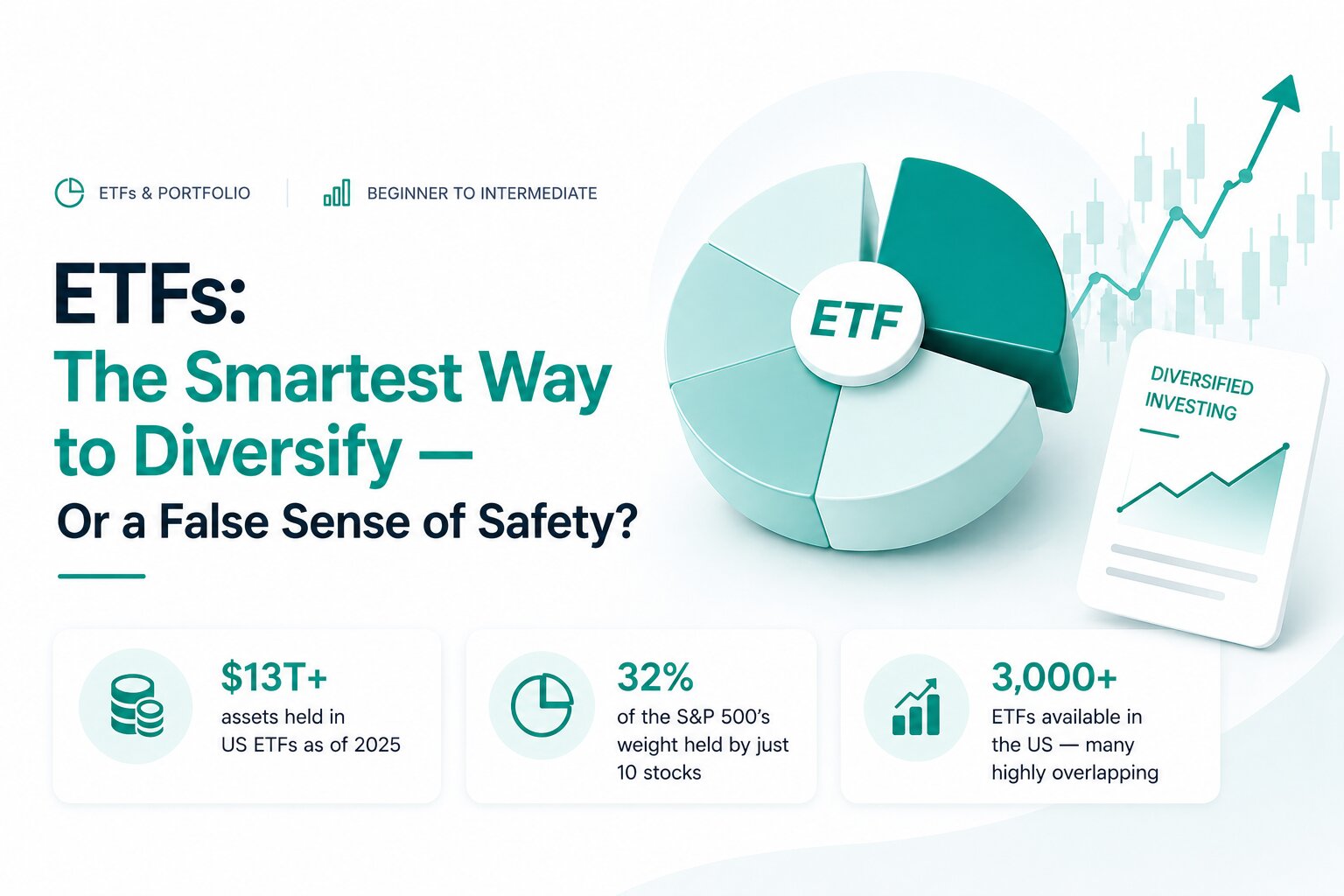
ETFs: The Smartest Way to Diversify —
Or a False Sense of Safety?
ETFs are sold as instant diversification. But inside many of the most popular funds, the risk is far more concentrated than the label suggests.
Ask most retail investors why they own ETFs and you'll hear the same answer: diversification. It's the word the industry has built its entire marketing pitch around. Buy one fund, own hundreds of companies, spread the risk. Simple, clean, responsible.
And for a long time, that pitch was essentially accurate. The original ETFs — broad market index funds tracking the S&P 500, total market, or entire bond universe — genuinely delivered what they promised. Low cost, wide exposure, true diversification across sectors, sizes, and geographies.
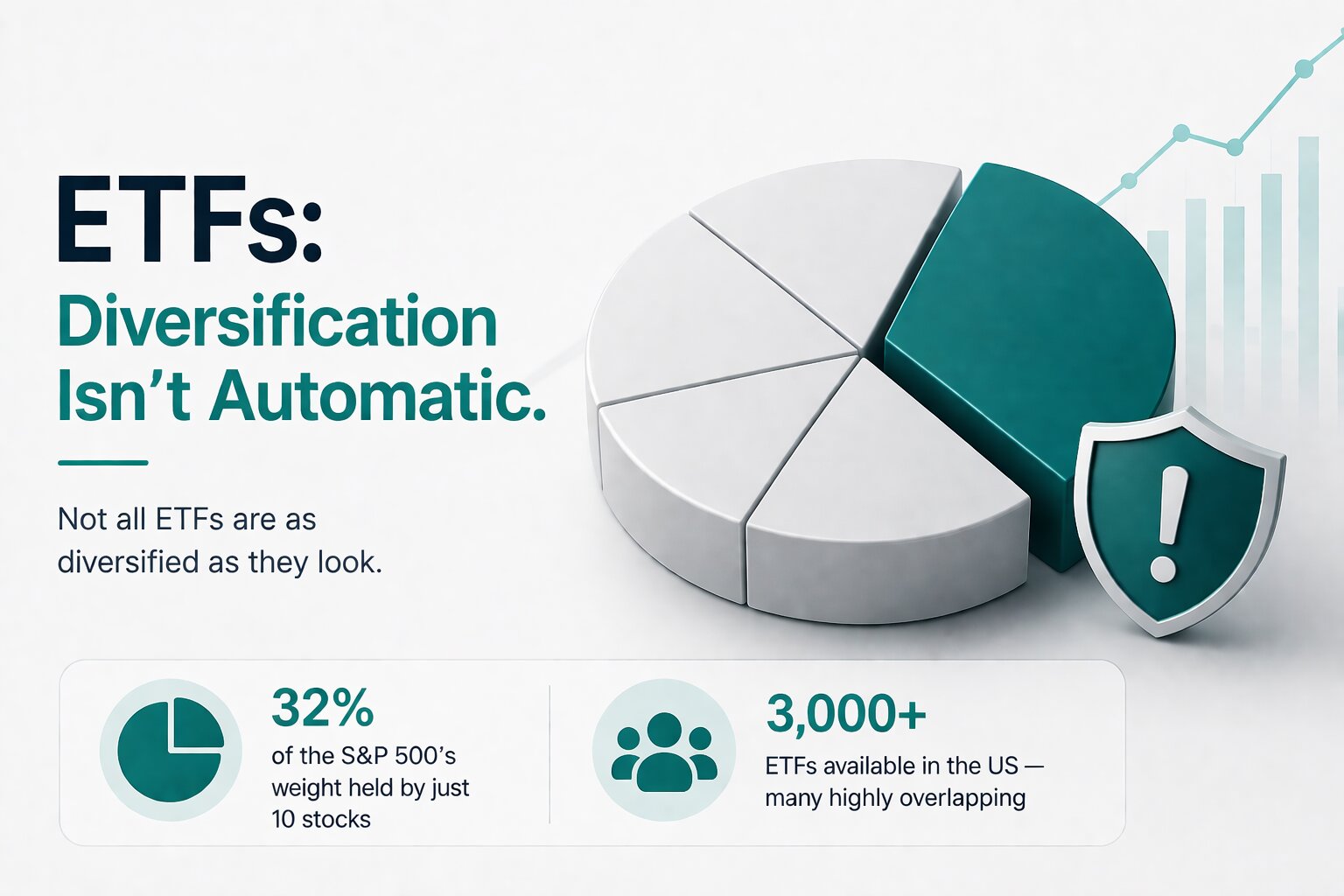
But the ETF market of 2026 looks nothing like that original promise. With over 3,000 funds available in the US alone, what investors are actually buying varies wildly from what the word "ETF" implies. Some funds are as concentrated as individual stocks. Others overlap so heavily with each other that owning three of them is functionally identical to owning one. And the thematic ETF boom of the early 2020s left behind a graveyard of funds that were really just single-sector bets dressed up in diversification language.
Understanding the difference between real diversification and the illusion of it is one of the most important — and most overlooked — skills in retail investing.
Source: Fund prospectuses and ETF.com holdings data, April 2026
The concentration problem hiding in plain sight
Here is a fact that surprises most retail investors when they first encounter it: the S&P 500 — the benchmark that hundreds of ETFs track, and the fund that most people picture when they think "diversified US stocks" — is not particularly diversified.
As of early 2026, the top ten holdings in a standard S&P 500 ETF account for roughly 32% of its total weight. That means if you own $10,000 of a broad market ETF, more than $3,000 of it is concentrated in ten companies — nearly all of them large-cap US technology firms. Apple, Microsoft, Nvidia, Amazon, Meta, Alphabet. You've seen the list.
This isn't a flaw in the ETF. It's a feature of market-cap weighting, which is how virtually all major index ETFs are structured. The bigger a company gets, the larger its share of the index. The result is that decades of technology sector outperformance have gradually turned a "diversified" US index into something that behaves very much like a technology fund with some other stocks attached.
"You think you own the market. You mostly own Big Tech with a long tail."
This wouldn't necessarily be a problem if investors understood it. The issue is that most don't. They look at "500 companies" and assume their risk is spread across 500 different stories. In reality, a significant portion of their portfolio's daily movement is driven by the same handful of mega-cap names reacting to the same macro forces — interest rates, AI investment cycles, regulatory scrutiny — in the same direction, at the same time.
The thematic ETF trap
If broad market concentration is one risk, thematic ETFs represent a different and arguably more dangerous one — because they are explicitly sold as concentrated products while being implicitly marketed as diversified ones.
The thematic ETF boom peaked around 2021. Clean energy ETFs. Metaverse ETFs. Genomics ETFs. Cannabis ETFs. Space exploration ETFs. Cybersecurity ETFs. Each was built around a compelling narrative: this sector is the future, get exposure now, across the whole industry so you don't need to pick winners.
The "whole industry" framing is where the sleight of hand happens. A clean energy ETF might hold 40 or 50 companies. But those companies are all subject to the same regulatory environment, the same subsidy structures, the same interest rate sensitivity (renewable energy projects are capital-intensive and particularly vulnerable to rising rates), and the same investor sentiment cycle. When the narrative turned — and it always turns — there was nowhere to hide inside the fund. Everything fell together.
Between 2021 and 2023, the ARK Innovation ETF lost over 75% of its value. The Global X Metaverse ETF lost more than 60%. Several cannabis ETFs declined by 80% or more from their peaks. Investors who thought they were diversified across an industry discovered they had taken a highly concentrated bet on a single macro thesis.
"Thirty companies in the same sector is not diversification. It's concentration with extra steps."
Source: Yahoo Finance historical price data. Peak drawdowns from respective highs.
The overlap problem: owning the same thing three times
There is a third diversification failure that is less dramatic but just as damaging to long-term returns: ETF overlap.
Many retail investors build what they believe is a diversified portfolio by owning multiple ETFs across different categories — a broad US market fund, a technology ETF, a growth ETF, maybe a Nasdaq tracker. What they don't realise is that these funds frequently hold many of the same companies, often at similar weights. Apple and Microsoft alone appear in hundreds of ETFs simultaneously, often as the top holdings in funds that describe themselves as covering completely different parts of the market.
The result is that an investor who believes they have a diversified four-fund portfolio may effectively have a portfolio that moves almost identically to a single large-cap tech position. Their perceived diversification is almost entirely illusory.
What actual diversification looks like
Real diversification — the kind that actually smooths portfolio volatility over time — has a specific, testable characteristic: the assets in your portfolio should not all move in the same direction at the same time, especially during market stress.
This is called low or negative correlation. Assets that are truly uncorrelated — or better, negatively correlated — provide genuine protection, because when one falls, the other either holds steady or rises. This is the original logic behind combining stocks and bonds in a portfolio, or adding international exposure to a US-heavy portfolio.
The problem is that correlations are not fixed. During normal market conditions, different assets and sectors move somewhat independently. During crises — 2008, 2020, 2022 — correlations spike toward 1.0 as investors sell everything indiscriminately to raise cash. The diversification you thought you had disappears precisely when you need it most.
This is a structural feature of the market, not a bug you can engineer away entirely. But you can build a portfolio that at least starts with genuinely different exposures, rather than one that only appears diversified on the surface.
Portfolio overlap analysis built in
Tirnu's portfolio view aggregates your holdings across ETFs and shows your true underlying exposure — not just the fund names. If you own five ETFs that are 70% correlated, you'll see it clearly before it costs you.
The index isn't the market
There's one more thing worth being honest about. The idea that owning a broad market index ETF means you own "the whole market" is a convenient simplification that doesn't quite hold up to scrutiny.
Market-cap-weighted indices, almost by definition, are backward-looking. They over-represent companies that have already grown large and under-represent companies that might grow large in the future. They reflect the market as it has been, not the market as it will be. Small-cap companies — where the most dynamic growth often originates — are tiny slivers of a total market index.
None of this means broad market ETFs are bad investments. For most retail investors, a low-cost total market index fund remains the single most sensible equity allocation available. But it's worth knowing what you actually own: a portfolio heavily weighted toward the companies that have already won, in a market that has already repriced those wins.
ETFs are excellent tools. Diversification is a feature you have to build — not one that comes automatically with the label.
Own a broad market ETF and you have a solid foundation. But know what's in it, understand its concentration, and don't mistake owning many funds for owning meaningfully different risks. Real diversification requires deliberate construction — not just the purchase of something that sounds spread out.
Understand your real exposure with Tirnu
Portfolio overlap analysis, correlation tools, and ETF screeners — know exactly what you own before the market tells you.
Explore Tirnu's Portfolio Tools