


BYD, Tesla, and Volkswagen Battle for EV Dominance in 2026

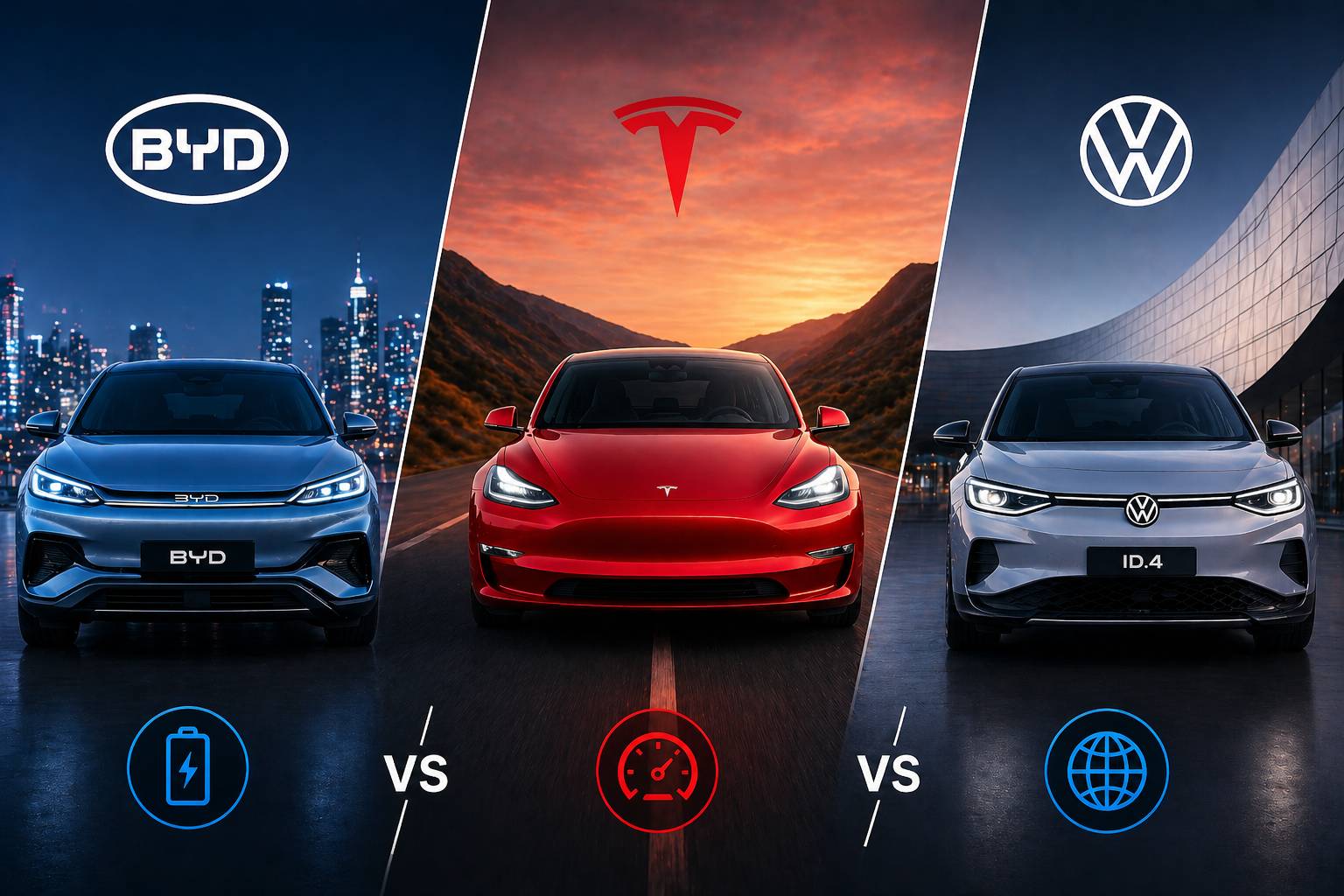
The EV Crown Changed Hands. Now Comes the Hard Part.
For a decade, the electric vehicle story had a single protagonist. Then, quietly but unmistakably, it got more complicated.
For years, the story of electric vehicles was essentially the story of one company. Tesla made the car people wanted. Tesla built the charging network. Tesla set the price everyone else scrambled to match. If you wanted to understand where EVs were going, you watched what Elon Musk did next.
That era is over.
In 2025, BYD sold 2.26 million fully electric vehicles — more than Tesla's 1.64 million, and the first time any company had outsold Tesla on pure battery electrics in a full calendar year. The margin was not particularly close. And the trend lines were moving in only one direction.
The EV market, in other words, has grown up. What was once a disruptor's sandbox has become a full-scale industrial war, fought on the dimensions that traditional automakers have always understood: cost, volume, margin, and distribution. The rules have changed. The players are different. And nobody — not Tesla, not BYD, not Volkswagen — has figured out how to win it yet.
The Shenzhen Factory That Changed Everything
BYD was not supposed to be here. Founded in 1995 as a rechargeable battery company, it spent its first decade making the cells that went inside Nokia phones. Cars came later, and EVs later still. For years, Western analysts dismissed it as a domestic Chinese story — impressive within its borders, but unlikely to travel.
What those analysts missed was the factory. BYD builds more of its own components — including batteries, semiconductors, and electric motors — than almost any automaker on earth. When the rest of the industry was scrambling to secure battery supply during the shortages of 2021 and 2022, BYD made its own. When competitors were absorbing cost increases, BYD was absorbing its own margins and still pricing aggressively.
The result is a company that can profitably sell a small electric car — the Seagull — for under $10,000 in China. Nothing Tesla or Volkswagen makes comes close to that price point. And as BYD's exports hit 1.05 million units in 2025, up 200% from the previous year, those prices are starting to show up in European showrooms, Brazilian dealerships, and across Southeast Asia.
"BYD is now in a scale-before-profit phase internationally," Bill Russo, founder of Shanghai-based advisory firm Automobility Limited, told Rest of World. "This inevitably weighs on margins." It does. But BYD's gross profit margin still reached 20.7% in early 2025 — higher than Tesla's 16.3% in the same period.
Tesla's Uncomfortable Year
A year ago, few people were writing Tesla's obituary. That remains true today. Tesla is still the most recognisable EV brand on the planet, still the only pure-play electric automaker turning a consistent profit, and still operating a charging network that its competitors would need a decade and hundreds of billions of dollars to replicate.
But 2025 was, by any honest measure, a difficult year. Deliveries fell roughly 9% compared to 2024 — the first consecutive annual decline in the company's history. By August, Tesla's US market share had dropped to 38%, down from around 80% just five years earlier. In Europe, the numbers were worse.
The reasons are layered. The federal EV tax credit that expired in late 2025 removed a meaningful purchase incentive for American buyers. Price cuts — implemented repeatedly to defend volume — compressed margins. And Elon Musk's increasingly visible role in American politics generated a backlash that, analysts broadly agree, cost the brand sales it would otherwise have made.
None of this is fatal. Tesla's bet on autonomous driving and robotaxi technology could, if it works, redefine the company entirely. But "if it works" is doing a lot of heavy lifting in that sentence. And in the meantime, Tesla is defending its position in a market it used to define — which is a fundamentally different posture than the one it held five years ago.
"The easy growth is over. China has raced ahead, Europe is settling into a steady groove, and the U.S. is working through a bumpy middle chapter."
Volkswagen's Long Game
Of the three companies, Volkswagen enters 2026 in perhaps the most ambiguous position. Its EV sales grew 25% in 2025, reaching 568,000 units. That is real growth. It is also, in global market share terms, about 2.7% — a reminder of how far the world's second-largest automaker by volume still has to travel in its own transition.
The challenges are structural in ways that neither BYD nor Tesla face. Volkswagen carries the weight of a century-old manufacturing infrastructure, labour agreements that constrain flexibility, and a software development operation that has repeatedly struggled to deliver what the company promised.
What Volkswagen has, though, is something BYD is still building and Tesla has largely chosen not to bother with: genuine global distribution. It sells cars in markets that neither of its main rivals can yet reach effectively. And it has a multi-brand portfolio — VW, Audi, Porsche, Škoda — that lets it address different price points without cannibalising itself.
The Map Is Splitting
One of the more underappreciated dynamics of the current EV market is that it is not, in any meaningful sense, a single market anymore. China accounts for roughly half of all global EV sales. Europe accounts for close to a third. The United States, despite its size, represents a high-single-digit share — and one that is currently shrinking rather than growing as incentive programmes are withdrawn.
This fragmentation matters enormously for how the competition plays out. BYD dominates where it dominates: China and, increasingly, the emerging markets where price sensitivity is highest. Its penetration in Europe is rising but still small. In the United States, it is essentially absent, blocked by a 100% tariff on Chinese-made EVs introduced in 2024.
Tesla is genuinely global but faces different headwinds in each region. Volkswagen, meanwhile, is most relevant in the markets that happen to be most uncertain right now: Europe and, to a lesser extent, the United States. A stronger European EV market is good for Volkswagen. A weaker one is a serious problem.
The Part Nobody Talks About: Profit
For most of the EV era, the conversation was about adoption. Those questions have not gone away. But a different question is now taking over in boardrooms and on earnings calls: who can actually make money at this?
The answer, right now, is not obvious. Battery costs have fallen dramatically — pack prices dropped to roughly $115 per kilowatt-hour in 2024, with projections of $80–$99 by 2026 — but so have vehicle prices, as companies cut to compete. BYD reported a 33% drop in third-quarter 2025 profit even as its sales remained strong. Tesla's margins have been declining for two years. Volkswagen is still losing money on most of its electric models.
The companies best positioned to weather this are the ones with the most control over their cost structures — which is, not coincidentally, why vertical integration has become the defining competitive advantage of the moment. BYD makes its own batteries. Tesla makes its own chips and motors. Volkswagen is catching up, but catching up costs money it is simultaneously trying to save.
The race for EV dominance has not been won. If anything, it has just started getting hard. The technology that was once the differentiator is now table stakes. What separates the winners from the rest — in this industry as in most — will be the less glamorous stuff: cost discipline, supply chain control, and the quiet, grinding work of turning a great product into a sustainable business.