

AI in Trading: Edge or Illusion? What Works in 2026 | Tirnu

AI in Trading: Edge or Illusion?
What Actually Matters in 2026
Everyone has access to AI trading tools now. So why are most people still losing money at exactly the same rate?
Every few years, a new technology arrives in financial markets promising to hand retail traders the edge that institutions have always held. Online brokerage in the 1990s. Algorithmic charting in the 2000s. Mobile trading in the 2010s. And now, in the mid-2020s: AI.
The pitch writes itself — machine learning models that scan thousands of assets, parse news sentiment in milliseconds, and generate trade signals with precision no analyst could match. Retail platforms including Tirnu now offer AI-driven signal generation, risk scoring, and portfolio optimisation in real time.
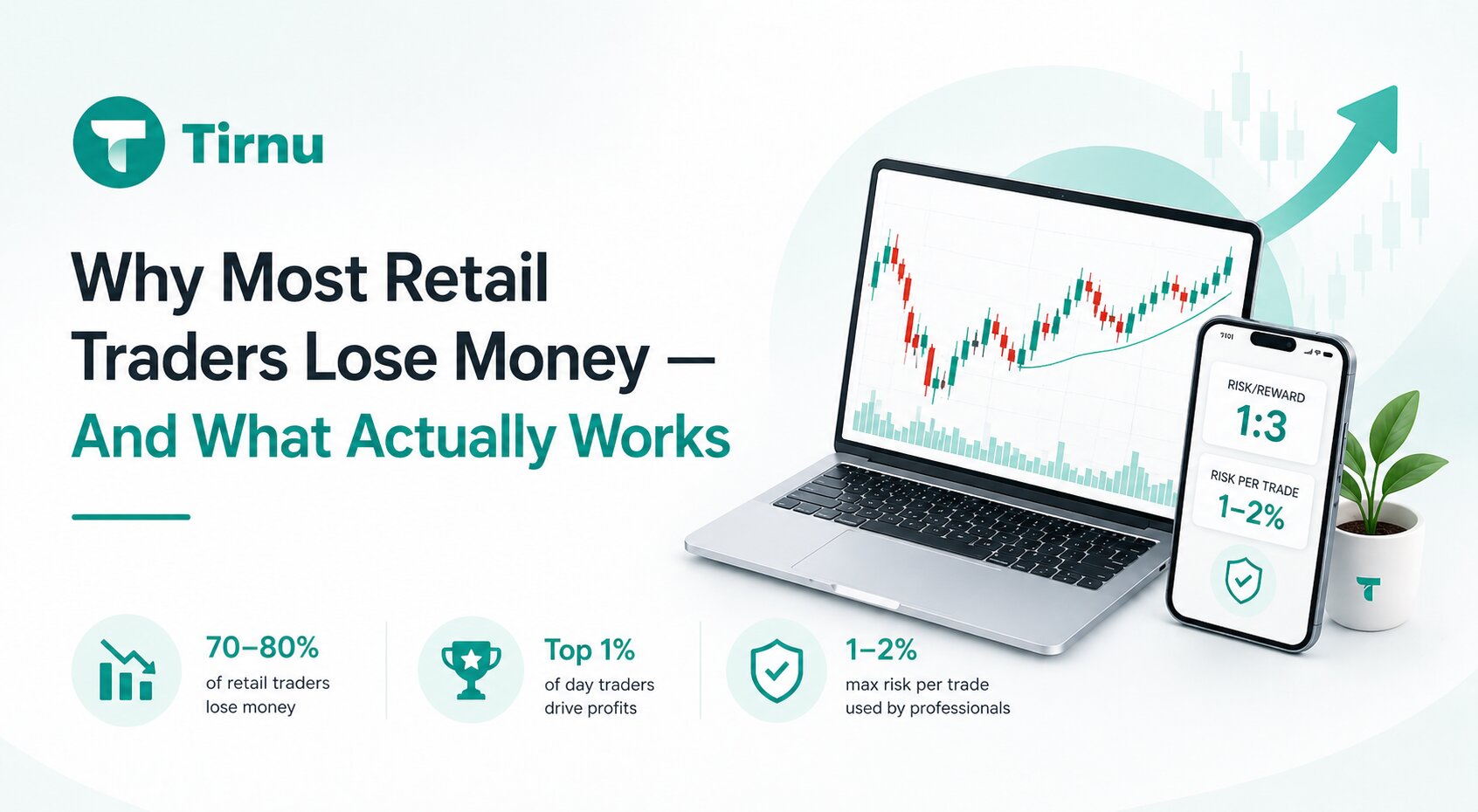
But there's an uncomfortable question the AI-trading marketing machine never answers: if this is such a powerful edge, why are retail traders still losing money at exactly the same rate they always have?
Sources: BarclayHedge AI Trading Report 2025; retail loss rate data from ESMA
The access illusion
Economists call it the commoditisation of edge. When an information advantage is exclusive, it generates alpha. When everyone has it, the advantage neutralises itself into price — and the edge disappears.
This has happened to every trading edge in history. Technical indicators went mainstream in the 1980s and their predictive power eroded. High-frequency trading advantages narrowed as latency races became infrastructure wars. Options pricing models moved from proprietary secrets to free spreadsheets. AI is following exactly the same path, just faster.
The GPT-4-level models available to retail traders in 2024 were already running inside hedge fund systems in 2021. By 2026, every serious retail platform offers some form of AI-assisted signal generation. The barrier is gone.
"When everyone holds the same edge, it isn't an edge. It's just the new baseline."
This doesn't make AI useless. It means you need to be far more precise about which problem you're using it to solve — and whether that problem is the actual one costing you money.
What AI is genuinely good at
Strip away the hype and AI does a handful of things in a trading context exceptionally well.
Speed and volume of data processing. A well-trained model can ingest a decade of price history, cross-reference macro indicators, scan news sentiment, and flag pattern anomalies before a human can open a second browser tab. For traders who rely on systematic screening — finding three setups worth considering from two hundred candidates — this is genuinely useful.
Removing recency bias from analysis. Human traders instinctively overweight recent events. A bad week makes every setup look risky. A good run creates overconfidence. AI has no memory of last Tuesday's loss. Used to stress-test a trade idea against historical conditions, it provides a more emotionally neutral second opinion than any human could.
Pattern recognition at scale. Certain microstructure patterns — order flow imbalances, volatility regime shifts, correlation breakdowns between asset classes — are nearly impossible for humans to catch in real time. Models trained specifically on these signals can surface them reliably. This is where institutional AI actually earns its keep.
What AI is genuinely bad at
This is the section nobody includes in the product marketing.
It cannot predict the future. Obvious in theory, constantly violated in practice. AI models are trained on historical data. They identify patterns that have occurred before and estimate the probability a similar pattern will repeat. In stable, regime-consistent markets, useful. In novel situations — a pandemic, a bank run, a geopolitical shock — the model has no relevant training data and its outputs become unreliable or outright wrong. Every major market dislocation has produced scenarios that made quant models catastrophically fail.
It overfits. A model trained to find patterns will find them — including patterns that are pure statistical noise. This is the silent killer of AI trading strategies. A backtest that looks spectacular may be fitting to randomness rather than genuine signal. Without deep expertise in model validation, retail traders have no way to tell the difference.
It doesn't account for market impact. AI models are trained on price data from liquid markets. They don't know you exist. When a signal tells you to buy a thinly-traded small-cap, the model has no concept of what happens when you — and the other thousand people running the same tool — all try to buy at once.
"The model doesn't know it's being used. The market does."
Assessment based on institutional adoption patterns and peer-reviewed quant finance research, 2024–2026
How professionals actually use it
The gap between how institutions and retail traders use AI explains the performance difference almost entirely.
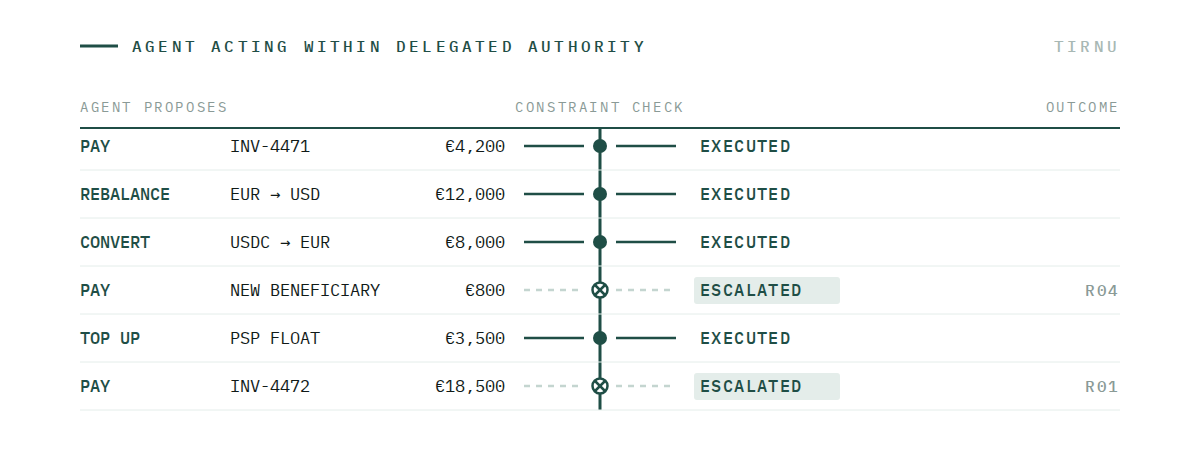
Institutions deploy AI as a component within a larger, human-governed system. A quant fund might use a model to screen for volatility anomalies, but a human portfolio manager decides whether the macro environment makes that signal actionable. The AI generates inputs. Humans make decisions.
Retail traders — particularly newer ones — tend to use AI as an oracle. Signal output becomes instruction. When the model says buy, they buy. When it says the probability is 78%, they hear "basically certain." It's a fundamentally different relationship with the technology, and a dangerous one.
AI-assisted screening, human-led decisions
Tirnu integrates AI signal filtering and risk scoring into the pre-trade workflow — not as an autopilot, but as a structured second opinion. Every signal comes with its historical accuracy rate and the conditions under which it typically breaks down. You decide. The model informs.
The amplification problem
There's a principle in finance that's easy to understand and brutally difficult to accept: AI amplifies what's already there. A disciplined, structured trading system becomes more efficient. An undisciplined, emotional approach becomes more expensive.
Consider a trader without a defined system who starts using AI signals. They now have more signals than before — faster, more confidently presented, dressed in statistical language that creates an illusion of rigour. Their overtrading doesn't decrease. It increases. Their position sizing doesn't improve. It gets more erratic, because now there are more "good reasons" to break the rules.
A 2024 study from the Swiss Finance Institute found that retail traders who adopted AI signal tools without prior trading education showed a 23% increase in trading frequency and an 18% deterioration in risk-adjusted returns within six months. The tool made them worse.
Swiss Finance Institute Working Paper, "Retail AI Tool Adoption and Trading Outcomes" (2024)
The question you actually need to answer
The conversation about AI in trading has been framed wrong from the start. The industry asks: "Should you use AI?" The right question is: "What specific problem do you have, and is AI the right solution to it?"
If you spend four hours manually screening stocks every morning, AI can fix that. If you exit winning trades too early because you get nervous, AI cannot fix that — that's a discipline problem, and no technology resolves discipline. If you don't know what your edge is, AI cannot give you one. It can only amplify whatever you're already doing.
The prerequisite to benefiting from AI is having a defined system. Not a vague preference for momentum stocks or a feeling that you read charts well. An actual, rules-based framework — defined entries, defined exits, defined position sizing — and a track record, even a short one, that tells you where your system breaks down.
AI is a multiplier, not a foundation.
Build the foundation first.
You wouldn't hand a Formula One car to someone who hasn't learned to drive. The car doesn't compensate for the missing skill — it just makes the crash faster. AI in trading works exactly the same way. Get your system right. Then use AI to make that system more efficient, not to replace the parts of it you haven't built yet.
How to use AI without the traps
Separate AI signal tracking built in
Tirnu's trade journal automatically tags whether a trade was initiated from an AI-generated signal or manual analysis. After 30 days, your performance dashboard breaks down returns by signal source — so you know empirically whether the AI is helping your specific strategy.
"The edge in 2026 isn't having AI. It's knowing exactly how to use it — and when not to."
The tools available to retail traders in 2026 are genuinely more powerful than anything that existed five years ago. But the fundamental truth hasn't changed: the traders who win over time understand their own process deeply, manage risk obsessively, and treat every tool — including AI — as something that serves their system. Not something that replaces the need to have one.
Trade smarter with Tirnu's AI tools
Signal filtering, risk scoring, and trade journaling — designed to support your system, not replace it.
Explore Tirnu's AI Features